Gen Z's French revolution | France's police force injure 400, mutilate four & mass arrest 5000 schoolchildren protesting for their education.
France's government is turning military-grade weaponry on its own schoolchildren, and arresting teenagers as young as 13. Students protesting for their education rights have become the new frontline for the movement to defend France's democracy itself.
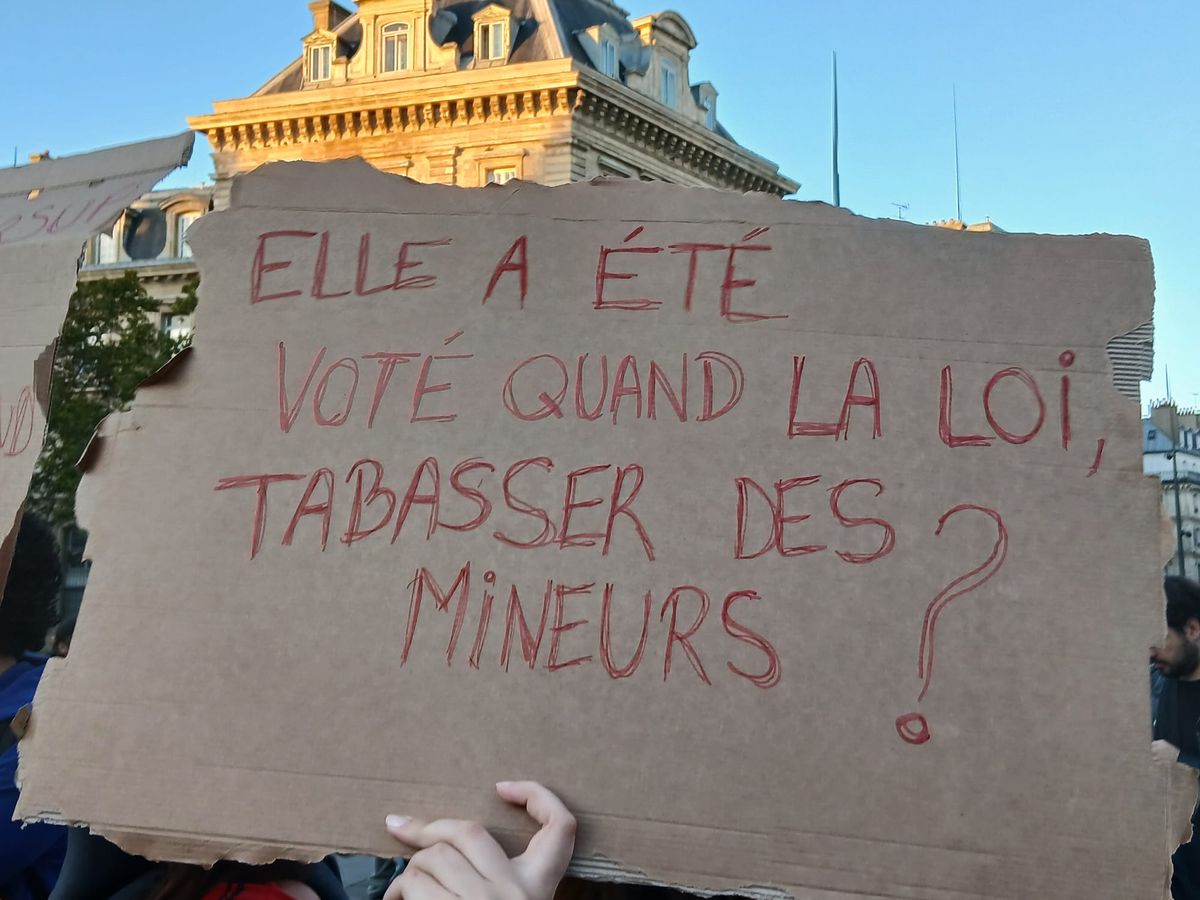
Warning: some links contain footage of extreme police violence.
Lycée Balzac, Tours. A child shot in the eye by a police officer, confirmed with a military-grade, Lanceur de Balles de Défense (LBD) "defence" gun.
Lycée Georges-Braque, Argenteuil. A child shot in the eye by a police officer, with a military-grade LBD "defence" gun.
Lycée Château d'Epluches, Saint-Ouen-L’Aumône, Val d’Oise. A child shot in the jaw by a police officer. Double fracture and upper teeth shattered.
Lycée Leclerc-Navarre, Alençon, Normandy. A police officer choking a child in a stranglehold.
Lycée Marie-de-Champagne, Troyes, Aube. Police officers driving at speed toward schoolchildren sending them scattering while spraying tear gas from the windows.
Lycée Blaise-Candrars, Sevran, Saint-Denis. Police officers reportedly fire flash-balls at schoolchildren. And into the leg of a parent teacher representative. Officers on horseback heading into children.
Lycée Paul Eluard, Saint Denis. A police officer crushing a child’s head on the ground.
Lycée Val de Seine, Grand-Quevilly. Police officers firing grenade-launchers at children.
Rennes. Police officers assaulting a child.
Lille. Police officers unleash dogs on children. 15 and 18-year-olds' skulls cracked against concrete.
"Ce sont des enfants ! Ce sont des enfants !" "They are children! They are children!" A mother sobbing in just one of the dystopian scenes across France as people form human chains or put their own bodies between school students and the police meant to protect them.
This morning, from homes around the country, France's lycéens again rose at dawn, grabbing cardboard signs, saline solution, and headed off to protest the way French sixth-formers, too young to vote, have for generations - by dragging bins to stage blockades at their schools.
Under watchful parents, who at worst risked a truncheon blow when they blockaded lycées in the '90s, the police officers waiting at school gates today are, as one mother put it: "armed-to-the-teeth robocops." Equipped with military-grade weapons that president Macron and his successive governments have invested their parents' taxes in, rather than education.
Reports are coming in now, that a 15-year-old who set out for his school in Lens, in northern France this morning, has lost his hand - after riot police fired a grenade. "Words have failed me these last few days, so much shock and anger has overwhelmed me," shared the Paris singer Emily Loizeau, sounding the alarm for mothers of France. "Our police, armed to the teeth, gasses children, strangles them, beats them, shoots them, and disfigures them."
Lawyers, magistrates, teachers, parents groups, human rights defenders, unions, the breadth of France's civil society has condemned what the French government has ordered police to do to its schoolchildren. "This brutal repression goes against the principles of a democratic state," decried France's League for Human Rights, the Ligue des Droits Humains, which has appealed to the UN and alerted France's independent constitutional authority for human rights - Défenseur des Droits.
"It's not normal. They're attacking minors. Repression through terror is not normal," decried C, a student at a school blockade school near Nation, east of Paris last week.
As of lunchtime on Monday, 5th Oct, latest figures are 400 schoolchildren injured. While the Inspection Générale de la Police Nationale (IGPN), the police authority that investigates police, has so far opened five cases into the circumstances that led to life-altering wounds inflicted by police officers on teenagers' bodies. In mass repression, police have arrested 5000 schoolchildren, with some 2000 kept in custody.
"Repression through terror is not normal."
France's government has allowed police officers to use "all intermediary weapon available" on the equivalent of Year 11 students and sixth-formers. "Intermediary weapons" is the term for arms between a truncheon and weapons of war. Considered to be sub-lethal, the French police's arsenal incudes LBD guns that can partially-blind, tasers and chemical toxic gas grenades particularly harmful for children's lungs.
The Ministre de L'Intérieur, Laurent Nuñez openly declared live on TF1 television channel on Friday, that "no order of restraint" has been issued to police. In chilling rhetoric, Nuñez suggested those involved be denied the status of children. "We forgot that they are school students, they are simply thugs, delinquents," he told TF1." And the internal security forces are doing their job remarkably well and apprehending them."
Victims associations beg to differ. "The violence of police interventions is unprecedented," said SAVE. The association formed to Stop State Violence called for the government to resign over the "clear assaults on the physical and psychological integrity of thousands of children and adolescents, a violation of their most fundamental rights."
"clear assaults on the physical and psychological integrity of thousands of children and adolescents, a violation of their most fundamental rights."
Decrying ministers' failure to de-escalate, Le Syndicat de la Magistrat hailed the students' righteous anger. The leading magistrate union sounded the alarm of schoolchildren being gassed, brutal arrests and the use of "mutilating sublethal weapons."
On Friday, the public prosecutor of Tours, a town in the Loire, confirmed that despite surgeons' efforts, a 16-year-old schoolboy shot by a police officer lost his right eye.
A video last Wednesday showed Maël sat before a pool of the blood that had poured from his eye.
Yet the very next day, in the Paris suburb of Argenteuil, another teenager was shot, also with a "defensive" bullet launcher, Lanceur de balles de défense (LBD). Like Maël, another of France's schoolboys risks partial blindness. The LBD guns French police are firing into crowds of schoolchildren are categorised as A2 weapon of war, derived from a model of military grenade-launcher.
Human rights groups and eye surgeons have implored successive French governments to ban LBD guns for policing protests. Dozens of injuries on civilians, included 23 people "éborgnés" the French word for people shot in the eye and partially-blinded. Experts have repeatedly called for LBDs to be used only in self-defence or situations of extreme violence when there's no alternative.
Earlier last week, a 14-year-old schoolboy, Eden, had his jaw fractured and his teeth shattered when a police officer shot him in his face with a chemical gas grenade at point-blank range. His devastated family is pressing charges for attempted murder.
Parents are watching their schoolkids head out to protest, knowing that their child risks mutilation for life. And waking to the reality that, in the words of Nicolas Framont, a sociologist and editor-in-chief of Frustration Magazine: "fascism is already here."
"We want to open your eyes But you blind us!!!" exclaimed one student's sign.
"We want to open your eyes But you blind us!!!"
This is Gen Z's May '68.
The same government which banned mobile phones in schools in September, citing risks of screen time to students' critical thinking, is now finding Gen Z versed up in their legal rights, the need for officers to show their RIO, their identification number and capturing their every brutality on camera.
Now into their third week of organising across Snapchat and Tiktok, some of France's lycéens are living their best lives. Their new un-boxing trend is what's inside your school blockade kit, while the movement has its anthems, viral hits of schoolchildren outrunning police, and what blockade a school will invent next.
With teenagers suddenly released from France's long, 8-6 pm schooldays, the atmosphere is the heady excitement of a festival, of aura battles, fancy dress.
This morning, in Metz, East of France, a class set up their chairs out on the street to protest the bare minimum inside. Then Metz riot police showed up firing choking chemical gas.
French police, notorious for indiscriminately firing chemical gas, violating UN guidelines, are turning it on schoolchildren despite documented evidence that it is particularly dangerous for younger lungs. "Gassing young people is an act of violence against children," declared the single mothers movement Mouvement des mères isolés as it encouraged mothers to protect the blockades.
"Gassing young people is an act of violence against children."
Escalating criminalisation of the right to protest, France's justice minister, Gérald Darmanin, speaking on RTL, urged French courts to impose fines on parents.
The Collectif Action Judiciaire, which is providing legal support to arrested teenagers has called for more legal professionals to join their ranks to help defend children's rights. Lawyers have denounced obstruction in obtaining access to teenagers while in custody, assaults on schoolchildren while being detained, plus intimidation on families to discourage them pursuing legal action against the police violence their children have suffered.
By Friday, the current Education Minister Édouard Geffray had ordered 400 lycées to close, moving lessons online and even banning gatherings in streets around closed schools. Authorities outlawed gatherings around 11 of the underfunded schools in the 93 département, with no time limit. An affront to the democratic right to protest that lawyers, teachers and student unions are challenging in court today, 5th Oct.
It took more than 10 days of protests, for Geffray to meet representatives of the Union Syndicale Lycéenne. A list of demands: the abolishment of the discriminatory university selection process, Parcoursup, thousands more university places, an emergency plan to repair and climate-adapt school buildings, recruit teachers, reform school timetables and elect democratic representation in every lycée.
Acte III: national day of protest 6th Oct.
With no concrete propositions from Geffray, the third week of the protest movement is forging ahead, with a national day of protest on 6th Oct.
The abysmal conditions in France's lycées, where pupils aged 15 to 18, some as young as 13, finish school, have become the frontlines of a wider movement against the government's 2027 budget and the destruction of France's social system.
Despite protests and strikes, Macron and his governments have spent the past decade turning France into a neo-liberal U.S.-style war economy.
For its 2027 budget, the government is trying to force another €54 billion in cuts to funding for public services, while still putting an additional €6.4 billion towards the military. In Macron's France, taxes are funnelled to the weapons' industry, behemoth companies and billionaires, while the middle class is disappearing and working-class people -now the poorest they've been in 30 years - are going hungry.
Under the 10 years of Marcon's presidency, the budget for the army, with the majority spent on weapons, has doubled. From €32 billion in 2017 to €63.5 billion for 2027. While the budget for education has actually declined from €68.4 in 2017 to a planned €65.53 billion in 2027. With a loss of 10 000 teachers under Macron, sixth-formers, even in their final year, have found themselves in classes without a teacher.
When lycéens went back to school in September, in classrooms still overheating in over 30°C, every other school in France was at least one teacher short.
For staff at the Lycée Saint-Exupery in the Paris suburb of Créteil, the count was even worse. Three teachers down, without a deputy head or a school nurse, Saint-Exupery's teachers had enough and went on strike. When the local education authority didn't respond, the students barricaded the school.
Within a week around a dozen lycées in the underfunded Paris suburbs had formed their own blockades. By Wednesday 30th Sept., the movement had spread across the rest of France to 365 schools. By Thursday, the protests involved almost 1000. And then: France's university students also joined the movement, with sit-ins at 30 universities.
"Violence is the system, the mistreatment, the oppression; it is not the resistance to the latter."
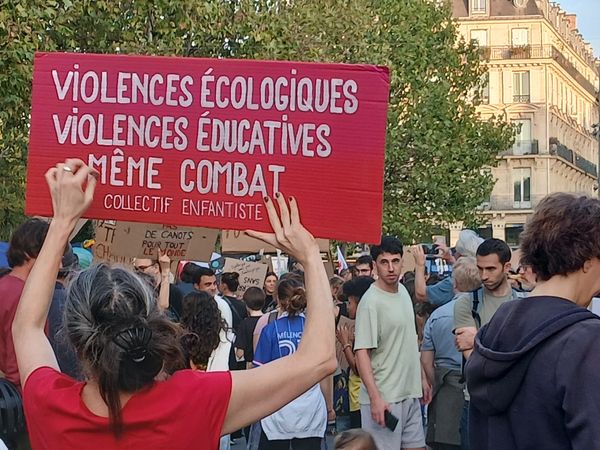
Emerging from schools in the suburbs, France's schoolchildren protests have been portrayed as "urban violence." "Discrediting, silencing, and beating children who aspire to a better life... It's the quintessence of paternalism and patriarchal violence," observed Louis Espargillère, journalist in an article for independent media Vert.
While the government perpetuates its narrative of "clashes," teachers, some also injured by police, report blockades without incident until riot police were sent in. "When the police come, they do whatever they want," said C. "It's super dangerous for the students. They are supposed to protect us."
In France where 80% of private media is owned by nine billionaires, damage to property is given more exposure than schoolchildren losing eyes. Rolling coverage shows burning bins, school buildings and a fire at the Lycée Nelson Mandela in Nantes, started by outside agitators according to students there.
The media's portrayal of social movements as "violent" seeks to make people forget the real violence, declared writer Claire Touzard on her socials. "Violence is the system, the mistreatment, the oppression; it is not the resistance to the latter."
Ahead of the presidential elections, billionaire Vincent Bolloré's far-right CNews channel also seeks to smear La France insoumise, with suggestions France's largest leftwing opposition party was engineering the protests. And another smear attempt on Bally Bagayoko, who has been the target of racism since he became mayor of Saint-Denis in March. Members of LFI were repeatedly filmed at blockades to support school students after Jean-Luc Mélenchon, LFI's presidential candidate, asked party members to put themselves physically between schoolchildren and the police in order to protect them.
As fast as smear campaigns try to discredit the schoolchildren's movement, a generation born on screen is exposing every attempt. In Reims, for example, a man in plain clothes filmed appearing from behind a bus stop to launch what appeared to be a chemical gas canister, and challenged by the LFI politician Anthony Smith, was later confirmed to be police.
In Belfort, where a police officer was violently set on by schoolchildren, another earlier video shows the same police officer trying to drown a student, holding their head under water. The student's lawyer affirmed that version of events to Le Monde - stating his client had been the victim of attempted drowning prior to the group attack. He is now filing an attempted murder case against the officer in question.
Media observatory Acrimed exposed the bias on France's national public channel, France 2. 75% of coverage about the protests discussed "violence," "fires," "bin fires," or "clashes" between school students and police. Mentions of a possible "disproportionate response" by the police, was given just 3%, of airtime. 47 seconds split over three different news reports. France 2 also spent longer broadcasting the false news regarding LFI, 12% than reporting the reasons why thousands of school students are protesting, 8%.
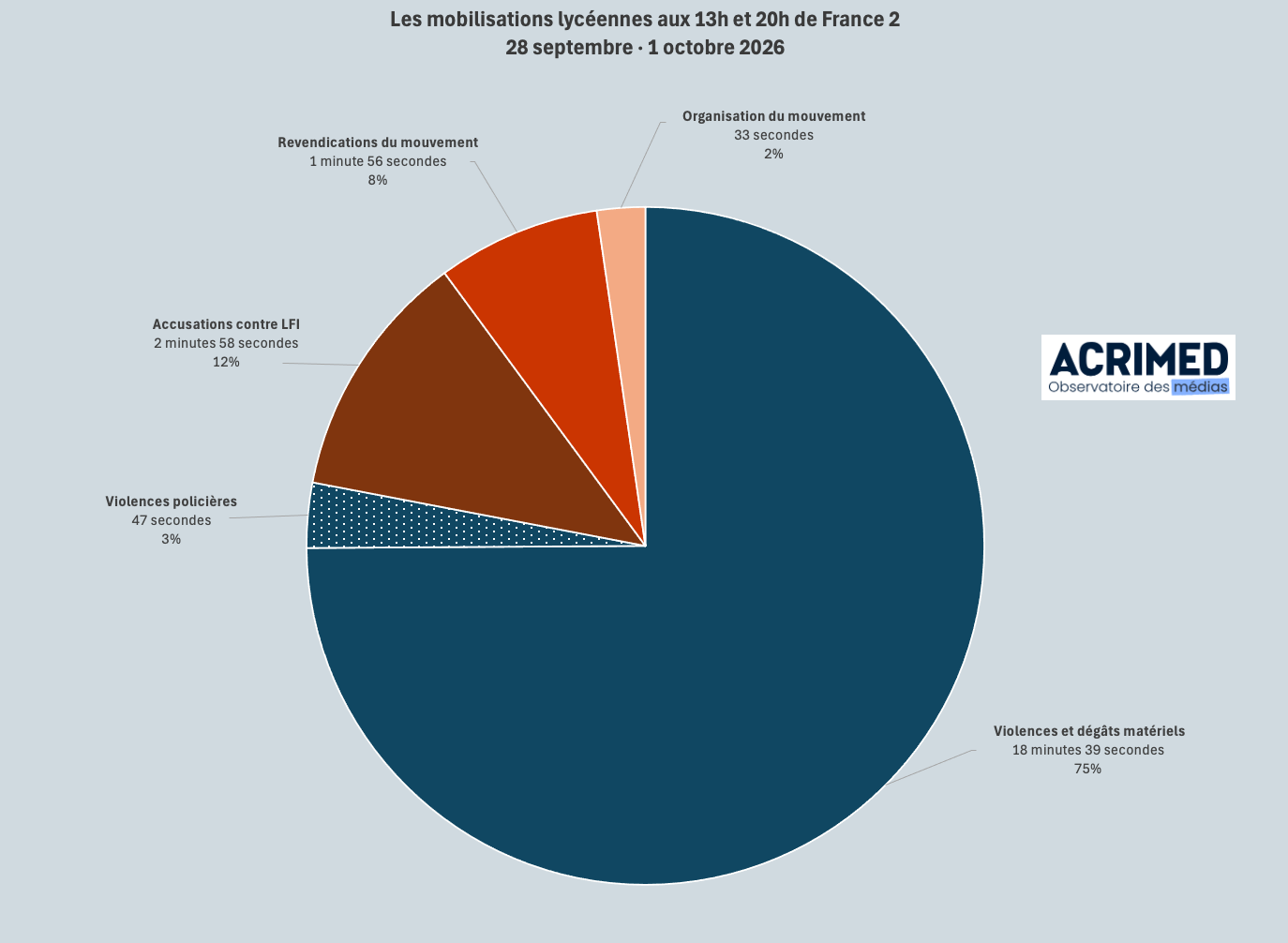
Credit: Acrimed
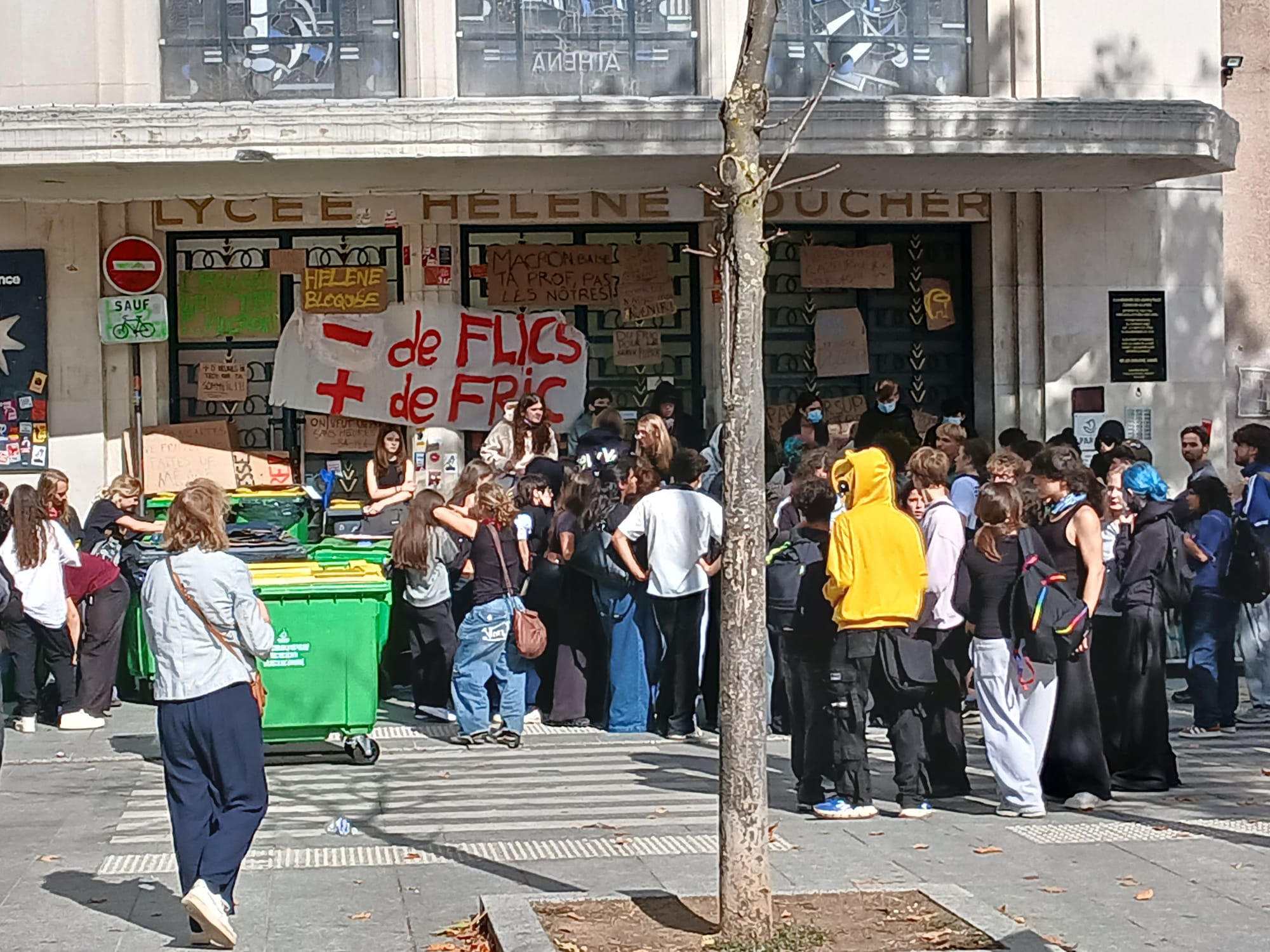
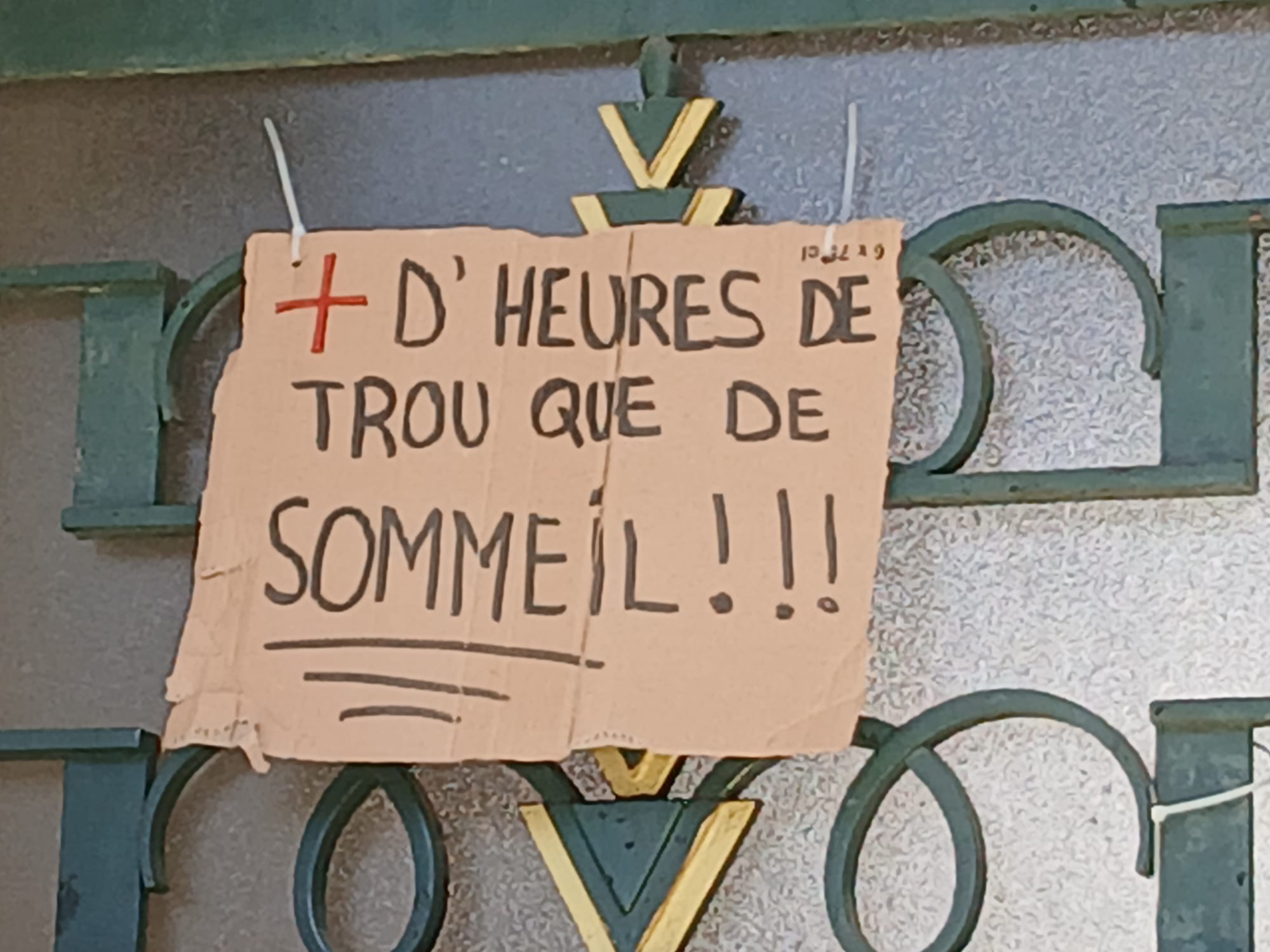
"More hours of missed classes than sleep!!!"
"From Saint-Denis to Paris, the same schooling!"
"This is our first blockade!" exclaimed a 14-year-old as she ran through the reasons why she was perched on a wheelie bin outside the Lycée Hélène Boucher east of Paris. "We've been on so many protests and weren't listened to so we had to find other ways to make ourselves heard. "The Education [system] is doing everything to cause total burnout," said her classmate sat on top the next wheelie bin next to her. "We have more hours of lessons than we do sleep."
"I had lessons on the 5th floor where it was so hot, barely insulated, broken blinds, no air conditioning, no fans. We had to take our individual Bac exams all together in the gym because it was the only place cool enough," explained another. "One of my teachers is pregnant, we have no idea if she will be replaced and we're in our final year."
While all was quiet outside Hélène Boucher, with no police present, pupils were keeping tabs on the nearby Lycée Paul Valery where riot police had charged at students. While their feeds follow the suburbs where police deploy far greater violence. "We are privileged to be in Paris, but in schools in the suburbs, it's worse; we protest also for them," C said. "They have even fewer resources, fewer teachers. We have classes of 35, which is already a lot. They have 40, 45!"
"Nous on a les moyens, mais vous vous avez rien," chanted the voice of a growing class consciousness in Paris schools. 'We have the means, but you have nothing.'
"De Saint-Denis à Paris, la même école publique," "From Saint-Denis to Paris, the same public schooling," students chant. Along with "Nous on a les moyens, mais vous vous avez rien," "We have the means, but you have nothing."
Tackling inequality in the underfunded suburbs, where students first launched the schools blockades, is a key protest demand. On Sunday, students held their press conference at the Lycée Paul Eluard in Saint-Denis, in the 93 département. A 2023 viral video of its dilapidated building, showed rats, a ceiling collapsing, while Paul Eluard's budget was once again reduced this year.
"For more than a week, the sixth-formers of our city have been standing up," mayor Bally Bagayoko told the crowd. "They are not asking for the moon. They are asking for teachers in front of every class, decent buildings, and class sizes that allow for learning. They demand the right to a future, and not to be the forgotten ones of the Republic, because they grew up in Seine-Saint-Denis."
Teenagers in Saint-Denis, and other working-class neighbourhoods are on the frontlines of police violence. Here in Saint-Denis, students' legitimate anger, mayor Bagayoko said, has been answered "with tear gas, arrests, and police custody." And the violence of the media bias on top. "Journalists must seriously address what is happening if they want to be fair, and that is what this youth demands."
What is happening begins with an education system designed for some to fail. "Even if I have all the will in the world, I'm not going to make it," explained Salma, a student at the Lycée Berthelot in Pantin, also in the 93, in a video. With a month without her teacher in her final-year speciality subject and no idea when the teacher is coming back, "What do I do on the day of the Bac?" she asked. The Bac is the equivalent of A Level. "There's Parcoursup. We don't even have a teacher. We are left with nothing, as if we, children from the suburbs, don't matter."
"We are left with nothing, as if we, children from the suburbs, don't matter."
Abolishing Parcoursup, the discriminatory selection platform for university introduced after Macron's election in 2018, is a key student demand. Where once a place in higher education was open to all, Parcoursup, is a competitive algorithm deciding who gets a place, leaving thousands of students without one. Pushing those who can afford it to private universities and some of those who can't - towards signing up for the army.
This year alone, unions said 120,000 young people have been excluded from continuing on the path to university. "Another windfall to swell the ranks of a young people sacrificed to be made available for the needs of an army," slammed unions. They accuse Sebastien Lecornu's government of coercing France's young people towards joining up through the French unemployment service France Travail. A military recruitment fair targeting 17-year-olds takes place in Paris later this week.
Concerned parents have also been calling out the partnership between the army and France's schools. With a target of 4000 recruits in 2027, teachers are encouraged to promote voluntary military service to their students. The service, launched in September, pays €800 a month.
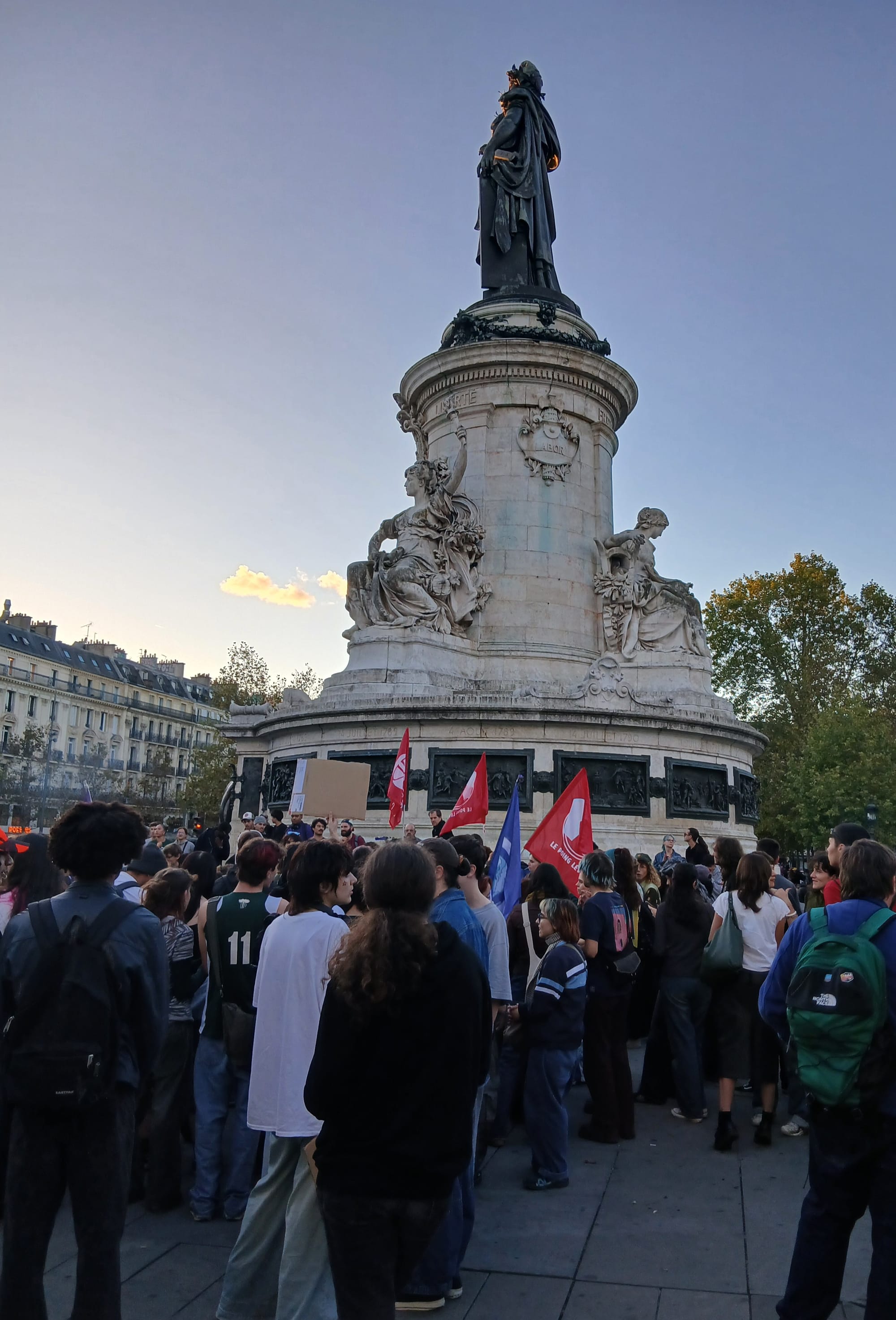
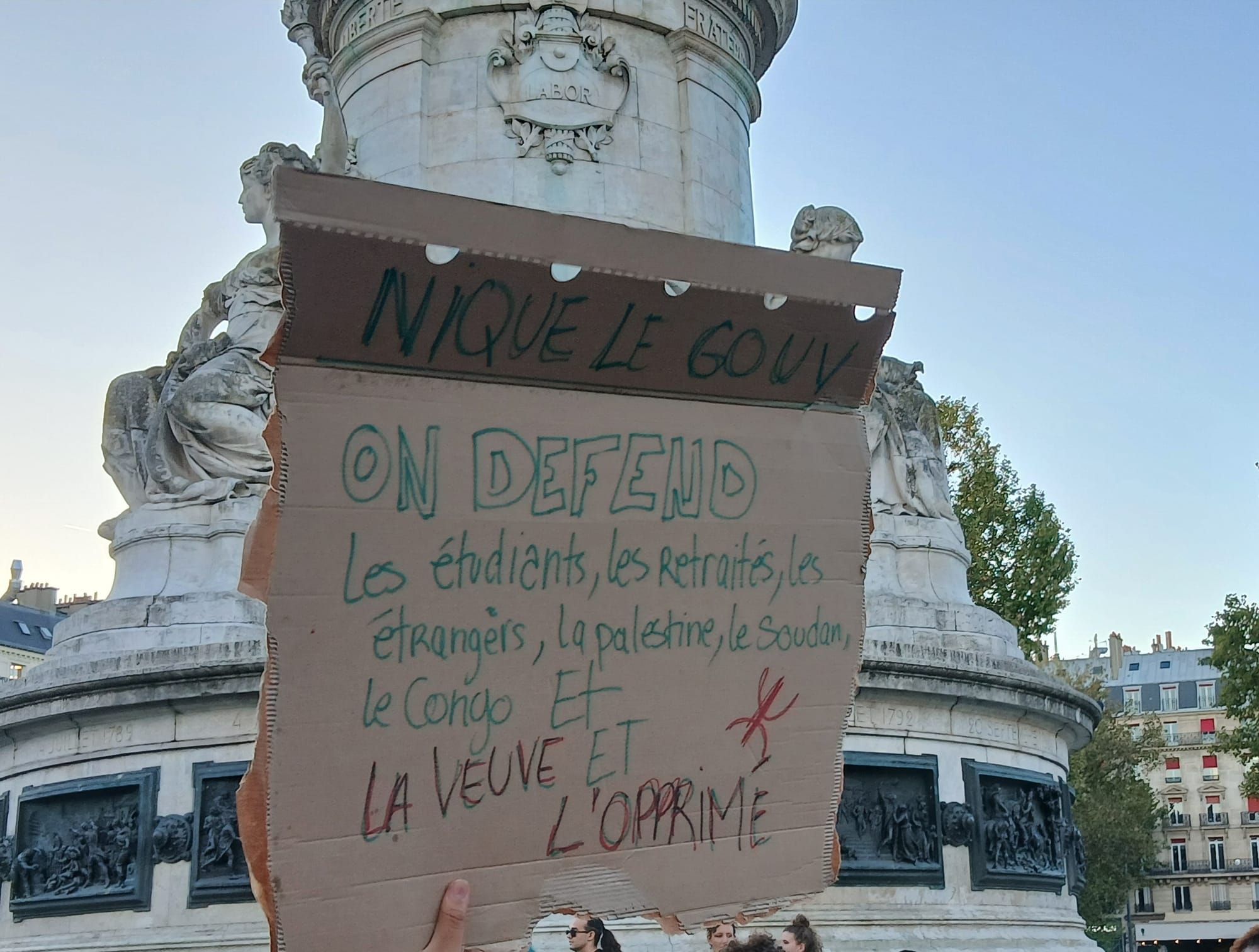
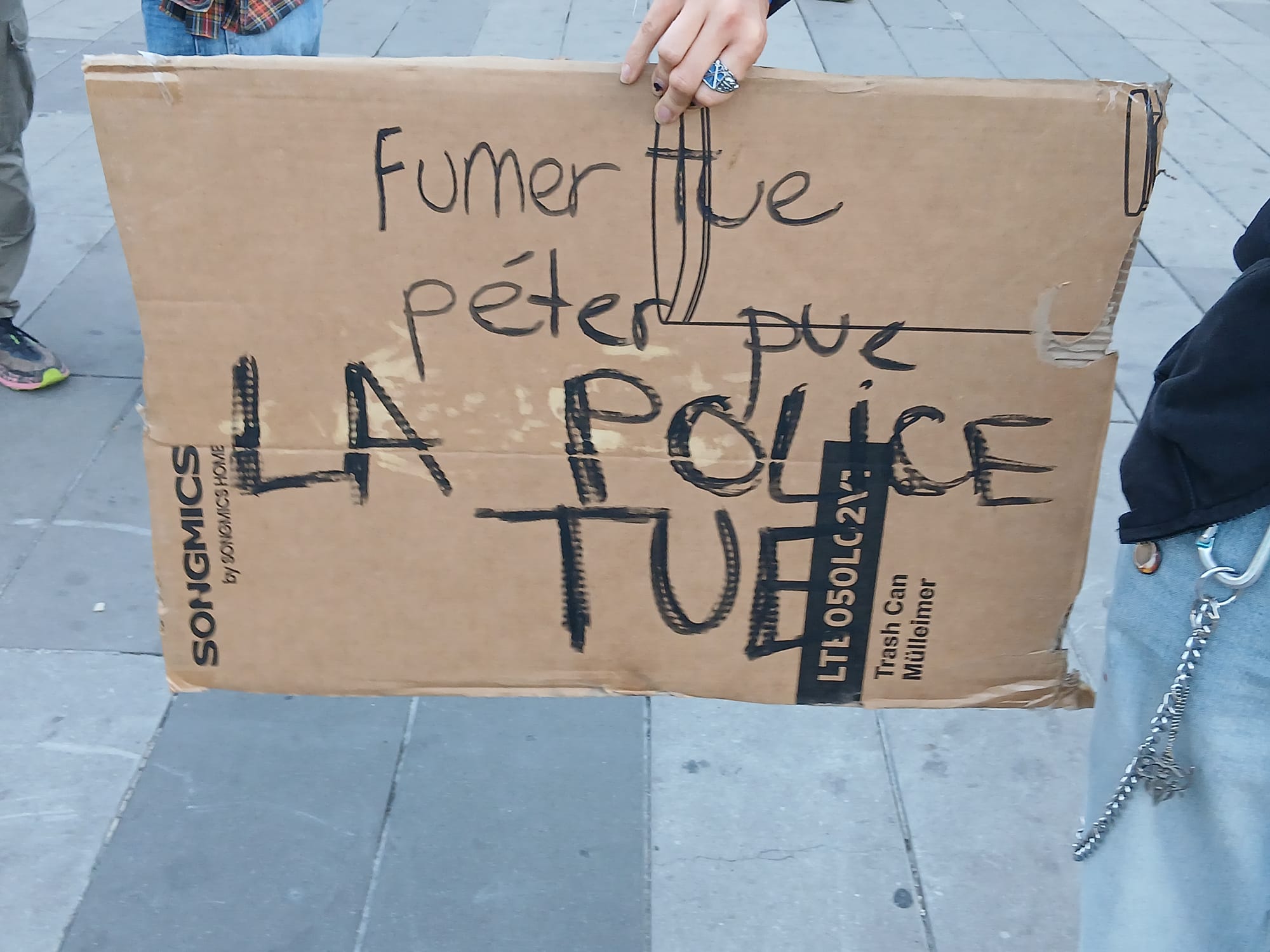
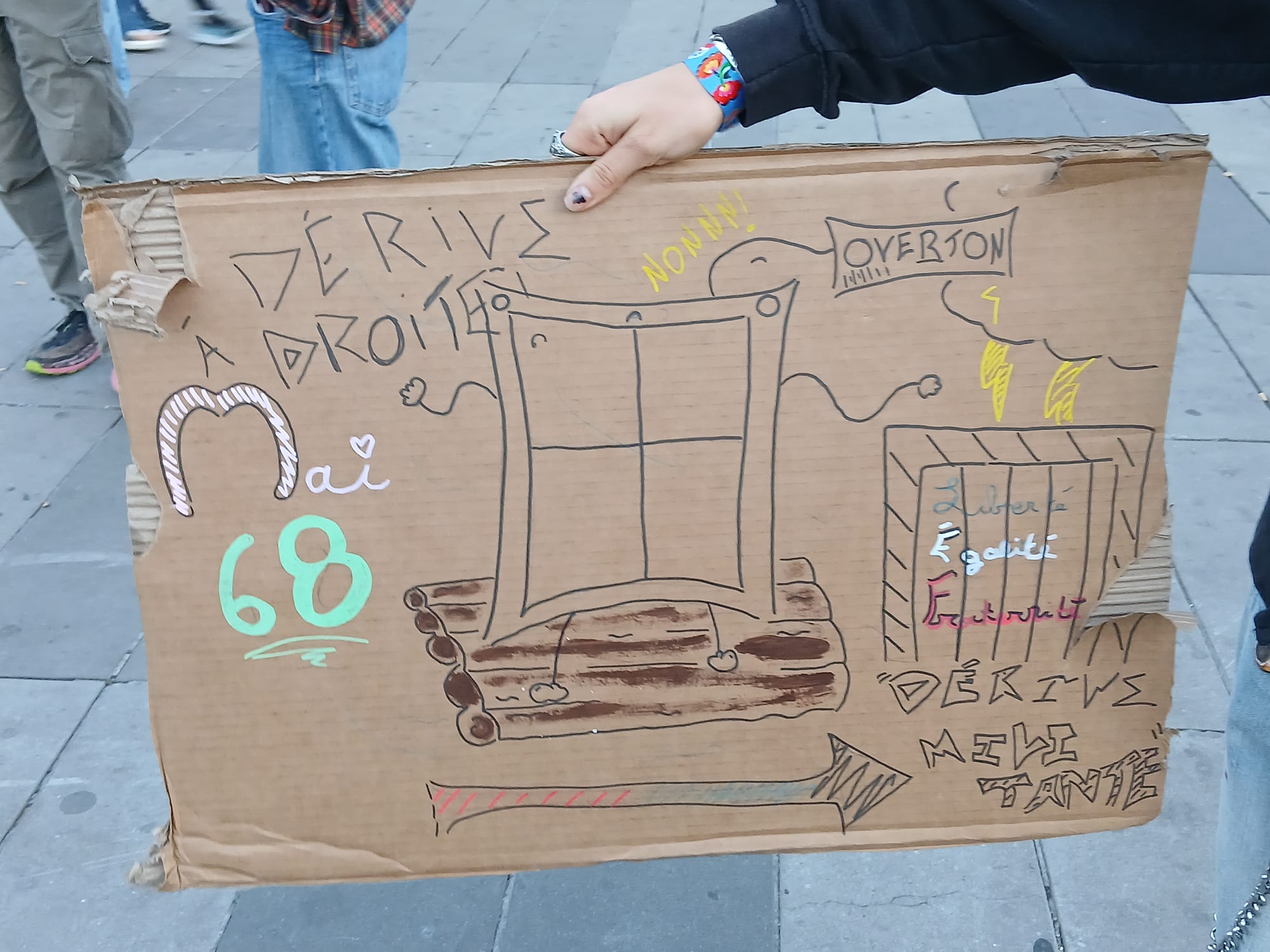
"We don't want to pay for wars. War itself is an enormous source of pollution."
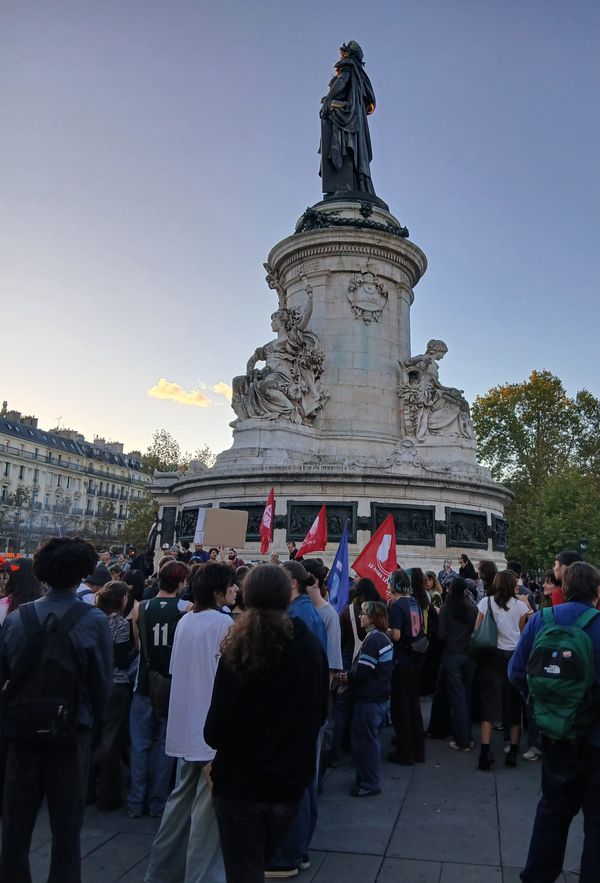
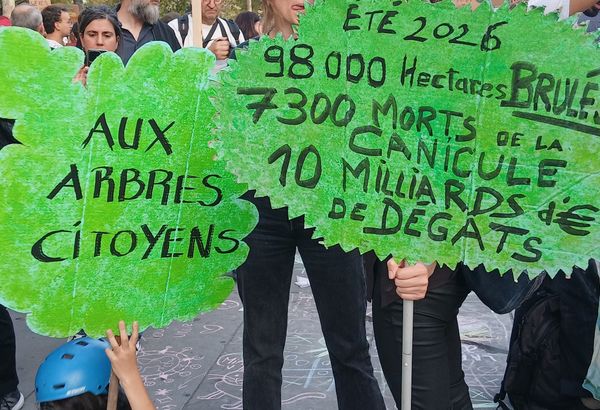
At Place de la République, E, a first-year student at the Sorbonne, whose family house in the Gironde escaped this summer's mega-fire called for climate, not military spending. "There's been lack of funding from the state, firefighters are very angry because they didn't have the equipment needed. That's why so much burned."
Holding a sign depicting the Overton window, she said cuts impact young people, and go toward the military, when they oppose armament. "We don't want to pay for wars. War itself is an enormous source of pollution."
"We see all the billions the government is giving to the big corporations and to the arms industry," said Aïcha Akoun, a nurse at the Hospital Saint-Antoine, a union member supporting students on the blockades. "I came for the students' protection, to make sure there were no problems with the police or Black Bloc outside agitators," she said. "Students are suffering and the response is to send in riot police, it's intolerable."
"Yesterday, all over France, they were beating up school students."
France's unions outraged at the French state's violence towards its children have now voted to join the national day of protest on 6th Oct. Further strikes and the return of the gilets jaunes, yellow vests movement are coming on 17th Oct.
"Yesterday, all over France, they were beating up school students," denounced Olivier Mateu, General Secretary of the Bouches-du-Rhone branch of France's largest union the CGT. "I will say it here and may they hear it loud and clear," he declared in a clip shared by independent media Cerveaux Non Disponibles. "We will make them pay for every blow of the truncheon, every drop of our children's blood they shed. Let them hear it! Let them hear! We are many. We are the ones who produce. They are nothing without us."
Unions slammed the government for endangering school students. "The intimidation and violence of the police will not silence us," stated the USL in a joint message with the Union Etudiante. "They think they can extinguish the movement, but they only make it blaze brighter."
Over the weekend, Confédération Paysanne, the France's farmers union called for its tractor drivers to join Tuesday. "Let's follow the path that the young people open for us!"
"When our struggles merge, when people come together, we see what rears up -state racism, systemic racism, police violence."
At République, "it's Gen Z 's time." a student orator told his peers.
"Everything I've seen over the past two weeks is something extraordinary, because how long have we been hearing that the youth of today couldn't mobilise?" he said. "When our struggles merge, when people come together, we see what rears up -state racism, systemic racism, police violence. That's what brings us together. Don't give up, keep going. Gloire à la lutte. Glory to the struggle."
Editor's notes: Stop State Violence, an association supporting victims, shared earlier estimates of at least 400 schoolchildren injured. SAVE says "assaults run into thousands of children and adolescents."
More than 6000 schoolchildren have now been arrested, by police officers issued instructions by Minister of the Interior, Laurent Nuñez, that "proportionate force should not inhibit re-establishing order."
Nunez, who authorised his police force to use the full arsenal of "intermediary weapons" which include military-grade weapons of war with the potential to blind and maim schoolchildren, "with no restraint," has declared 215 schoolchildren have been injured along with 700 police officers. It is not clear how the Ministry is tracking the numbers of schoolchildren injured.
Initials instead of names used to protect children's identities.
using 'chemical gas' to replace the term 'tear gas' to describe dangerous combination of explosive chemicals with serious, choking effects and health impacts especially on children.
 îles
îles